01
Electronic Health Records
Support consistent access to EHR and EMR platforms across hospitals, clinics and remote locations.

Modern healthcare runs on connected technology. EHR, medical imaging, AI, telehealth, cloud applications and connected facilities all depend on the network underneath them.
Massive Networks helps healthcare organizations connect hospitals, clinics, cloud platforms, data centers and critical applications through a simpler, high-performance network architecture.
Clinical applications are increasingly cloud-connected, data-intensive and real time. Network quality directly influences how quickly people, systems and locations can communicate.
Support consistent access to EHR and EMR platforms across hospitals, clinics and remote locations.
Move large diagnostic files efficiently between imaging systems, data centers and cloud environments.
Connect healthcare data to cloud and compute resources supporting emerging AI workloads.
Improve real-time voice and video experiences by reducing exposure to latency, jitter and packet loss.
Create high-performance connectivity to cloud platforms and critical healthcare applications.
Unify hospitals, clinics, imaging centers, offices, cloud resources and data centers through one architecture.
Healthcare AI can move large amounts of information between hospitals, cloud environments, storage platforms and computing infrastructure. Massive Networks helps create the network foundation connecting those environments.
Support movement of large imaging datasets between clinical systems and compute environments.
Connect distributed healthcare data sources with analytics and cloud platforms.
Bridge hospitals, private infrastructure, cloud services and data centers through a unified connectivity strategy.
Healthcare IT teams should not have to coordinate a maze of carriers, circuits, cloud connections, support desks and invoices just to keep critical locations connected. Massive Networks delivers Network as a Service (NaaS): a managed connectivity model that brings private transport, internet, cloud, data center, SaaS and office-to-office connectivity together through one network partner.
Consolidate connectivity, carrier relationships, provisioning, support and billing through Massive Networks instead of managing a fragmented provider environment.
Massive Networks backs its managed connectivity with continuous monitoring, proactive alerting and access to a U.S.-based support team.
Use the right network for the workload: private Layer 2 paths for sensitive or performance-focused traffic and premium internet where public connectivity is appropriate.
Connect hospitals and clinics to cloud platforms, SaaS applications, data centers and other locations through one managed connectivity architecture.
Add bandwidth, locations and connectivity services as healthcare applications, AI workloads and data requirements evolve.
Segment multiple independent connectivity services across a single carrier-grade Ethernet connection for greater simplicity and flexibility.
Bring multiple connectivity requirements together across one Massive Networks connection while maintaining distinct network services for different applications and destinations.
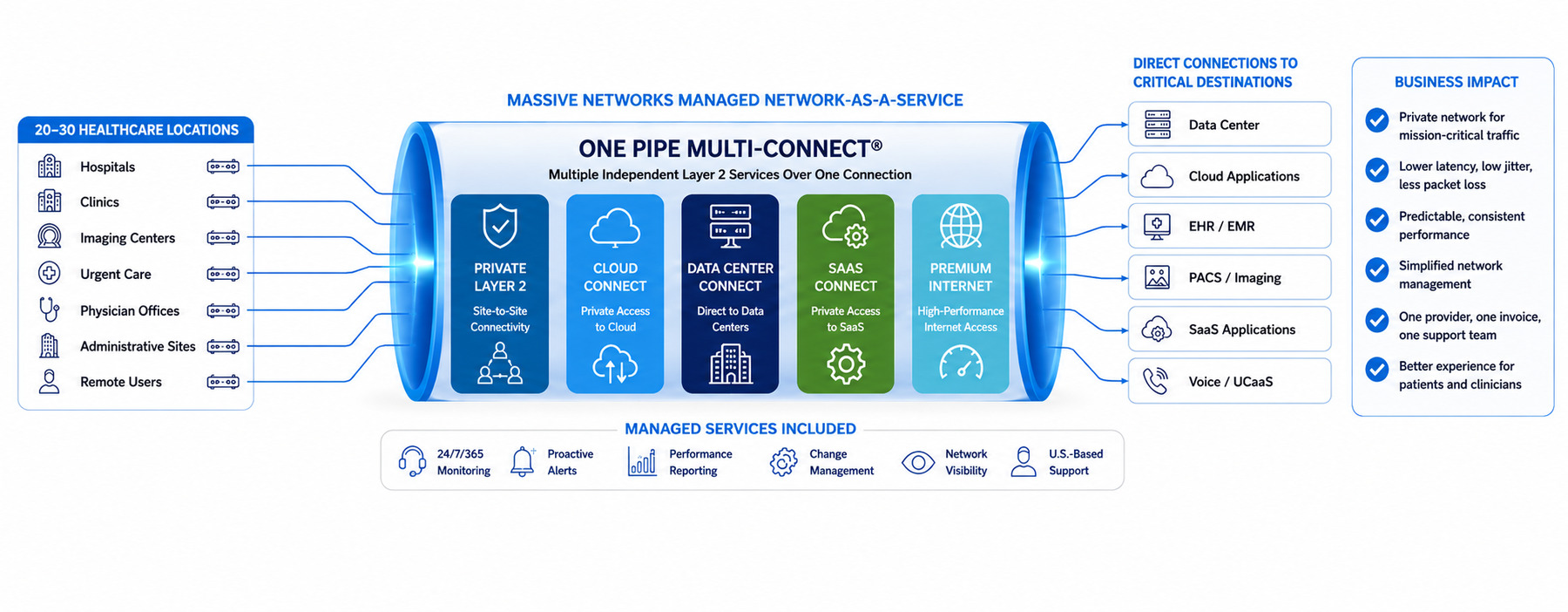
Healthcare networks have to do more than simply stay connected. They need to protect sensitive traffic, maintain reliable access to critical systems, and deliver consistent performance across facilities, cloud platforms, and Internet services.
Reduce exposure with private, segmented connectivity.
Keep appropriate site-to-site, cloud, and data center traffic off public Internet paths, while separating different network services into distinct segments.
Build resilience into every connection.
Use private network paths for critical workloads and Premium Blended Internet for multi-provider Internet access with best-path routing.
Give critical applications a more predictable path.
Private Layer 2 and direct cloud connectivity can reduce routing variability, congestion exposure, and unnecessary hops for latency-sensitive applications.
Designed for regulated environments where privacy, uptime, and operational control matter.



A medical billing SaaS provider needed to securely connect offices, clinics, data centers, and healthcare applications without relying on public-internet VPNs for critical traffic.
Massive Networks helped evolve the environment to private Layer 2 connectivity with redundant office and data center connections — improving performance, supporting HIPAA-sensitive workloads, and eliminating single points of failure.
Read the Medical Case StudyHIPAA-sensitive traffic moved away from public-internet VPN dependence.
Network performance scaled from 100 Mbps to 10 Gbps with dramatically reduced latency.
Redundant connectivity and a secondary data center improved geographic failover.
The public internet is extraordinarily useful because it connects almost everything. But traffic can cross multiple independently operated networks, follow changing routes and encounter congestion along the way. That best-effort model does not give a healthcare organization end-to-end control over every hop, latency event, jitter spike or packet-loss condition.
For web browsing and general internet access, that model often works well. For performance-sensitive healthcare workloads, Massive Networks can reduce reliance on the public internet by moving selected traffic onto private, segmented Layer 2 connectivity and more direct paths to offices, clouds and data centers.
Not every healthcare workload needs to rely entirely on public internet routing. Private Layer 2 connectivity can create more direct, controlled paths between healthcare locations, data centers and cloud environments.
Connect sites using private Ethernet connectivity for workloads that benefit from a more controlled network path.
Separate critical application traffic from general internet traffic and align connectivity with business requirements.
Expand bandwidth as imaging, AI, cloud adoption and connected applications increase network demand.
A fast network is not simply a large Mbps number. Healthcare applications can also be affected by latency, packet loss, jitter and actual throughput.
Connect hospitals, clinics, clouds, applications and data centers through a managed, high-performance network architecture — with private and public connectivity brought together through one network partner.